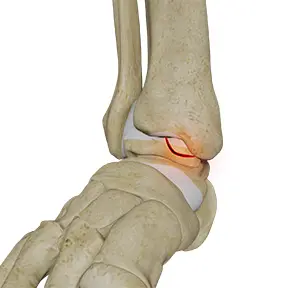





Talus fractures — fractures of one of the small bones at the back of the foot, sitting just below the ankle joint — are uncommon but among the most consequential fractures in the foot. They follow high-energy injuries, usually a fall from height or a road-traffic crash. And patients invariably ask: what does the future look like?
Why the talus is special
The blood supply to the talus is unusual. Most of the bone’s vascular input comes through a small region around the neck. When that area is damaged in a fracture, the rest of the talus can lose its blood supply — leading to avascular necrosis, where the bone slowly dies and collapses. The other major risk is post-traumatic arthritis, where the cartilage of the joints around the talus wears unevenly because the surface alignment was disrupted.
What we did
This 2023 paper, on which I was a co-author, looked at 100 consecutive patients with talus fractures presenting to our major trauma centre between 2012 and 2020. We followed their complications and outcomes carefully so that future patients could be told real numbers, not theoretical risks.
What we found
The average age was 35 years — consistent with the high-energy injury mechanism. Twenty-two per cent of patients had an open injury — the bone broke through the skin — which is a marker of severity. Talar body fractures were the most common pattern (47%); talar neck fractures (20%) were the most consequential.
The headline complication rates were: non-union (the bone failing to heal) 2%; avascular necrosis 6%; tibio-talar post-traumatic arthritis 12%. Open injuries and talar neck fractures carried the highest rates of all three.
What this means for patients
If you sustain a talus fracture, the rough numbers to anchor your expectations are: roughly 1 in 16 chance of avascular necrosis, and roughly 1 in 8 chance of post-traumatic arthritis. Both are higher if your fracture was open or involved the talar neck. Avascular necrosis can take 12–24 months to declare itself on imaging, so follow-up beyond the first year is part of the standard care, not a sign that something has gone wrong.
Source: Pradhan A, Najefi A, Patel A, Vris A, Heidari N, et al. Complications after talus fractures: A trauma centre experience Injury 2023. PMID: 36543737. Read the full paper on PubMed →