Ankle Arthroscopy (Keyhole Surgery)
All Treatments
Keyhole · Diagnostic & therapeutic

Ankle Arthroscopy (Keyhole Surgery)

Two small incisions, a tiny camera, and miniature instruments. Day-case surgery to address impingement, osteochondral lesions, and intra-articular pathology with minimal soft-tissue disruption.

AnaestheticRegional + sedation
StayDay case

Royal College British Orthopaedic AO Trauma Churchill Limb Recon Specialist Reg.
27
Years of practice
94
Publications
3
Sub-specialty areas
3
Central London clinics

Keyhole · Diagnostic & therapeutic

Ankle Arthroscopy (Keyhole Surgery)

Two small incisions, a tiny camera, and miniature instruments. Day-case surgery to address impingement, osteochondral lesions, and intra-articular pathology with minimal soft-tissue disruption.

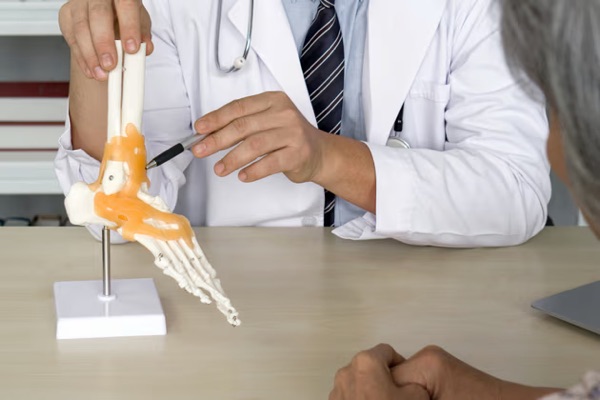
Arthroscopy means looking inside a joint. Through two or three small (about five millimetre) incisions, the surgeon inserts a camera and instruments to inspect, debride or repair structures inside the ankle joint. It is diagnostic — you can see exactly what is there, often more clearly than on MRI — and therapeutic — many of the things you find can be addressed in the same sitting. The most common reasons to do an ankle arthroscopy are anterior or posterior impingement (where bone or soft tissue gets pinched at the front or back of the ankle), an osteochondral lesion of the talus (a defect in the cartilage and underlying bone), loose bodies floating in the joint, synovitis, or removal of an os trigonum (an extra bone at the back of the ankle that causes pain in dancers and footballers). It is also routinely combined with other procedures — for example, an arthroscopic look at the start of an ankle ligament reconstruction is standard.

Because the incisions are so small, ankle arthroscopy is usually a day-case procedure with a faster, more comfortable recovery than open surgery. Most patients are walking in a supportive boot within a few days and back into normal footwear over the following weeks — though the exact timeline depends on what is found and treated inside the joint. A simple debridement recovers quickly, whereas a cartilage repair needs a longer period of protected weight-bearing to give the healing surface the best chance.

AnaestheticRegional + sedation
StayDay case
Keyhole surgery is not a smaller version of open surgery. It is a different operation — one that allows precise work inside the joint with very little disruption to the soft tissues around it.

Professor Nima Heidari

When this is right

  • Anterior or posterior ankle impingement
  • Osteochondral lesions of the talus
  • Loose bodies or persistent synovitis
  • Removal of os trigonum (back-of-ankle pain in dancers, footballers)
  • Diagnostic arthroscopy where imaging is equivocal

Recovery, step by step

The recovery pathway

Stage 1

Day-case under regional anaesthetic. Home with a soft dressing.

Stage 2

Foot up, walking allowed in a comfortable shoe.

Stage 3

Stitches out. Most patients off painkillers.

Stage 4

Driving and desk work returned.

Stage 5

Light running typically permitted.

Stage 6

Most return to all sport.

Common questions

What patients ask first

How long off work?
Desk work: a few days to a week. Standing or manual work: 3–6 weeks. Athletes follow a sport-specific rehab plan.
When can I drive?
Right leg: typically 2–4 weeks. Left leg with automatic: within days for most patients.
Will I need physiotherapy?
Usually yes, especially after work on a cartilage lesion or impingement. Range of motion first, then strength, then sport-specific drills.
What if it doesn’t work?
If symptoms persist, we reassess — sometimes the pain was coming from a different structure. Sometimes a second-stage procedure (for example, formal cartilage repair) is planned in advance.

Considering ankle arthroscopy (keyhole surgery)?

Book a consultation — the diary holds while you decide.

Book a Consultation →

Signed off on 30 July 2026