Ankle Fusion Surgery
All Treatments
Joint · End-stage

Ankle Fusion Surgery

Definitive surgery for end-stage ankle arthritis — the joint is permanently fixed, eliminating the painful movement. Reliable, well-evidenced, and with a very long track record.

AnaestheticRegional + sedation

Royal College British Orthopaedic AO Trauma Churchill Limb Recon Specialist Reg.
27
Years of practice
94
Publications
3
Sub-specialty areas
3
Central London clinics

Joint · End-stage

Ankle Fusion Surgery

Definitive surgery for end-stage ankle arthritis — the joint is permanently fixed, eliminating the painful movement. Reliable, well-evidenced, and with a very long track record.

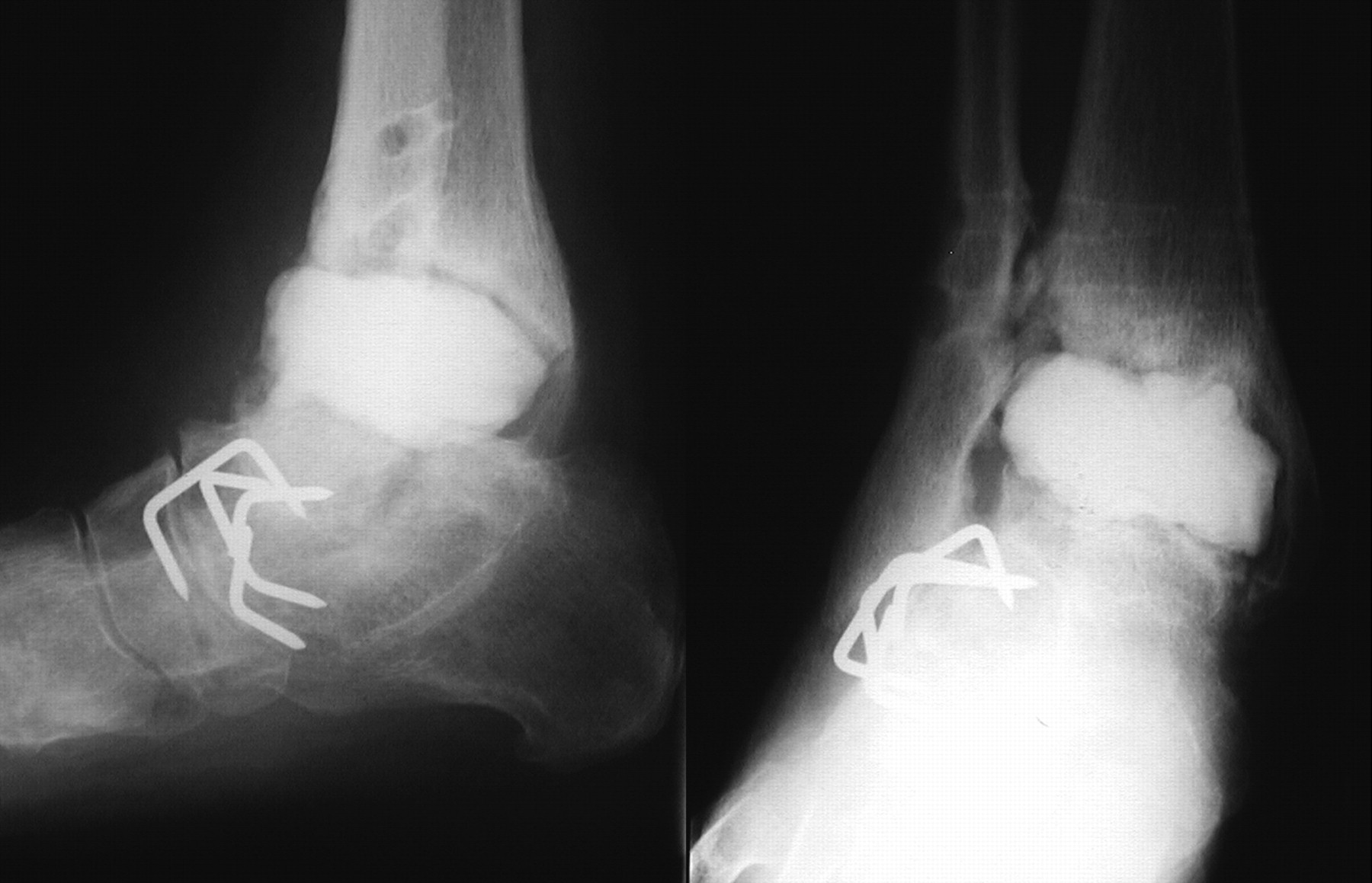
An ankle fusion (arthrodesis) joins the tibia, fibula and talus into a single solid block of bone. Once the bones have grown together — usually around 10 to 12 weeks — the joint can no longer move, and so it can no longer hurt at that joint. You lose the up-and-down motion of the ankle itself, but most patients regain a surprising amount of compensatory motion from the joints below (the subtalar joint and midfoot). For active patients with end-stage arthritis where joint preservation is no longer possible, fusion can be exactly the right call — it is reliable, well-evidenced, and durable. Professor Heidari performs fusion using either an open or an arthroscopic-assisted technique depending on alignment, prior surgery and bone quality. Both deliver the same end result: a stable, pain-free ankle joined securely with screws or a small plate. The decision between fusion and total ankle replacement is one of the most important conversations in this part of foot & ankle surgery, and it is talked through at length before any commitment is made.
AnaestheticRegional + sedation

Fusion is not a retreat from replacement. For the right patient at the right stage, it is the operation that delivers the most pain relief with the least to go wrong over a lifetime.

Professor Nima Heidari

When this is right

  • End-stage ankle arthritis (osteoarthritis, post-traumatic, inflammatory)
  • Failed total ankle replacement (conversion to fusion)
  • Severe deformity unsuitable for replacement
  • Younger, high-demand patients wanting durability
  • Active infection cleared and bone stock good

Recovery, step by step

The recovery pathway

Stage 1

Open or arthroscopic-assisted fusion under regional + sedation. Plaster cast or boot.

Stage 2

Stitches out. Cast change to a non-weight-bearing boot.

Stage 3

X-ray check. If healing is on track, partial weight-bearing begins.

Stage 4

Full weight-bearing, out of boot once X-rays show fusion.

Stage 5

Most daily activities restored. Cycling, swimming, gym easy.

Stage 6

Final review. Most patients describe being pain-free for the first time in years.

Common questions

What patients ask first

How long off work?
Desk-based work: around 4–6 weeks, once weight-bearing is established. Standing or manual work: 3–6 months. Phased return is usually arranged.
When can I drive?
Right leg: typically 10–12 weeks, once X-rays confirm fusion and you can brake confidently. Left leg with an automatic: from around six weeks.
Will I need physiotherapy?
Yes — physiotherapy concentrates on the joints around the fusion, on gait, and on reconditioning. Most patients walk surprisingly well after a fusion has healed.
What if it doesn’t fuse?
Non-union is uncommon when patient selection and technique are right, but it does happen. Revision surgery (with biological augmentation, bone graft, or different fixation) is the answer when it does.

Considering ankle fusion surgery?

Book a consultation — the diary holds while you decide.

Book a Consultation →

Signed off on 30 July 2026