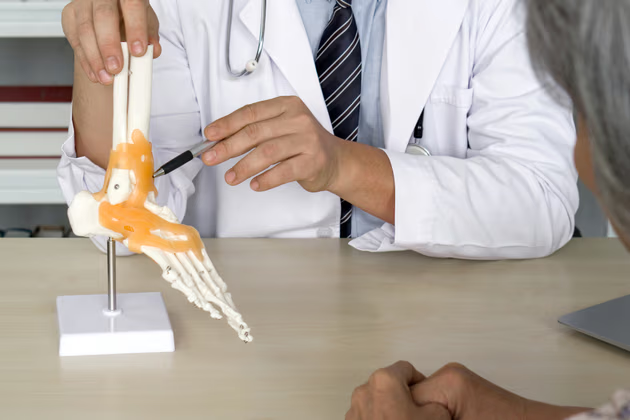





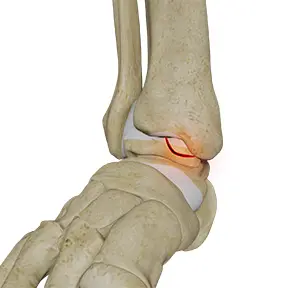
Ankle fractures are common — tens of thousands every year in the UK alone — and surgeons have known how to fix the inner and outer malleoli (the bony lumps you can feel either side of the ankle) for decades. The trickier question is what to do about the posterior malleolus: a fragment of the back of the tibia that often comes off in the same injury but is much harder to see and access.
The historical compromise
For much of the last century, the rule of thumb was that small posterior malleolar fragments — less than 25% of the joint surface — could be left alone. They didn’t reliably destabilise the joint, and the surgical access required to fix them was considered to add more risk than it saved. Larger fragments were fixed; smaller ones were left.
What we did
This 2021 paper, on which I was a co-author, looked at a major trauma centre’s consecutive ankle-fracture patients and compared outcomes between those whose posterior malleolus was fixed and those whose wasn’t. We measured outcomes using MOXFQ — the Manchester-Oxford Foot Questionnaire — which captures pain, walking, and social/emotional impact of foot problems.
What we found
Patients in whom the posterior fragment was fixed scored on average 20.1 on MOXFQ. Patients in whom it was left alone scored 24.0. Lower is better. The difference reached statistical significance (p = 0.04). It’s a modest difference, not transformative, but it points consistently in the same direction as other recent studies.
What this means for patients
If you have an ankle fracture that involves the back of the tibia, expect a conversation with your surgeon about whether to fix that fragment. The historical reluctance is softening. The current evidence, and our own data, supports fixing it in more cases than we used to.
Source: Jeyaseelan L, Bua N, Parker L, Sohrabi C, Trockels A, Vris A, Heidari N, Malagelada F. Outcomes of posterior malleolar fixation in ankle fractures in a major trauma centre Injury 2021. PMID: 33376016. Read the full paper on PubMed →