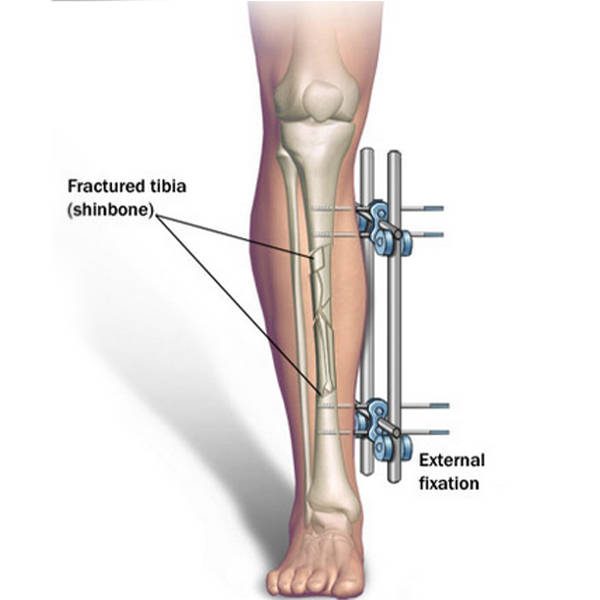





Of all the fractures we treat, the open shin-bone fracture — where the bone has broken through the skin at the moment of injury — carries the highest infection risk. Anywhere up to a quarter of these injuries can develop a deep infection in the months that follow, and once an infection sets up around the metalwork, the recovery becomes long, expensive, and sometimes limb-threatening.
The case for antibiotic-coated metal
The standard answer to that risk has been intravenous antibiotics around the time of surgery, plus rigorous wound management. But the metalwork itself sits there, day after day, with no antibiotic protection of its own. Antibiotic-coated nails are designed to fill that gap: gentamicin is bonded to the surface of the implant, releasing slowly into the surrounding bone for the critical first weeks after surgery.
What we did
This paper, published in 2023 with my co-authors, examined our experience using the ETN PROtect™ nail across 56 patients over three years at our major trauma centre. We looked separately at two groups: patients receiving the nail at the time of their initial open-fracture surgery (primary use), and patients receiving it as part of revision surgery for an already-established infection.
What we found
For primary use the result was striking. The deep infection rate was 1.8% — significantly lower than historical comparators. For patients with an already-established deep bone infection being revised onto a coated nail, the results were less encouraging: all five revision cases failed. The lesson is clear: this is a prevention tool, not a rescue tool.
What this means for you
If you have an open tibial fracture that needs nailing, ask about coated-nail availability. Used at the right moment — the first operation — it gives a meaningful infection-protection benefit. Once an infection has set up, however, the answer lies in different techniques.
Source: Patel KH, Galanis A, Balasubramanian P, Iliadis AD, Heidari N, Vris A. A major trauma centre experience with gentamicin-coated tibial intramedullary nails (ETN PROtect™) in acute primary open fracture fixation and complex revision surgery European Journal of Orthopaedic Surgery & Traumatology 2023;33(5):1745–1750. PMID: 35943591. Read the full paper on PubMed →