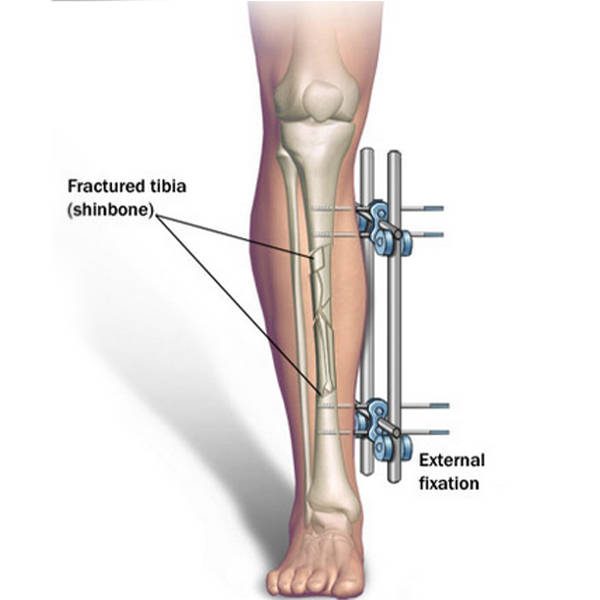





If you’ve had limb reconstruction surgery with an external frame — a metal scaffold around your leg held in place by wires that pass through the skin into the bone — you’ll have been told that pin-site infection is the most likely complication you’ll face. It usually isn’t serious. But it is the thing patients worry about, and it is the thing that, in the worst cases, can derail an entire reconstruction.
The state of practice was inconsistent
Until this 2022 review, every UK limb-reconstruction unit had its own pin-site protocol. Some surgeons used iodine, some chlorhexidine, some sulphadiazine; some told patients to clean daily, others weekly; some used solid pins, others fine wires. Outcomes varied. We pulled together every published study over a 13-year window to ask the simpler question: what actually reduces infection?
What the evidence supports
Three things came through clearly. First, the antiseptic itself: sulphadiazine and hydrogen peroxide both reduce infection rates compared with bland saline cleansing. Second, fine wires inserted with low-energy technique — meaning slow, cool drilling that doesn’t burn the bone — have lower infection rates than thicker pins put in faster. Third, hydroxyapatite-coated pins have a real, measurable infection-reduction benefit.
What makes no difference: how often you clean the pins. Daily and weekly cleaning produce the same infection rates. So the obsessive multiple-times-a-day routines we sometimes see are not improving outcomes — they’re just adding to the patient’s daily burden.
What this means for patients
If you’re heading into frame surgery, ask your surgeon about pin choice (HA-coated where possible) and pin-site care solution (sulphadiazine has the best evidence). Don’t feel guilty if your routine is weekly rather than daily — the data says that’s fine.
Source: Shields DW, Iliadis AD, Kelly E, Heidari N, Jamal B. Pin-site Infection: A Systematic Review of Prevention Strategies Strategies in Trauma and Limb Reconstruction 2022;17(2):93–104. PMID: 35990183. Read the full paper on PubMed →