Common Foot Conditions

Common Foot Conditions

The conditions most patients first present with — pain in the ball of the foot, an aching arch, a stubborn corn, an irritated nerve. None of these need surgery in most cases, but all benefit from a proper diagnosis before someone tells you to live with it.

Royal College British Orthopaedic AO Trauma Churchill Limb Recon Specialist Reg.
27
Years of practice
94
Publications
3
Sub-specialty areas
3
Central London clinics

Foot & Ankle · Professor Nima Heidari

Common Foot Conditions

The conditions most patients first present with — pain in the ball of the foot, an aching arch, a stubborn corn, an irritated nerve. None of these need surgery in most cases, but all benefit from a proper diagnosis before someone tells you to live with it.

There are several common foot conditions including flat feet, ganglions and ingrown toenails. Whilst they can often be painful, if diagnosed early many can be treated non-surgically, returning patients to their normal way of life as quickly as possible.

Flat feet (fallen arches) are extremely common and frequently cause no trouble at all. In some people, however, the loss of the arch leads to aching and fatigue along the inside of the foot and ankle, often involving the posterior tibial tendon that supports the arch. The majority settle with supportive footwear, orthotics and targeted physiotherapy — surgery is reserved for the minority whose deformity is progressive or whose pain persists despite these measures.

Ganglions are benign, fluid-filled swellings that arise from a joint or tendon sheath, most often over the top of the foot or around the ankle. They are harmless, but can be uncomfortable in shoes or where they press on a nerve. Many resolve on their own or with simple measures; aspiration or, occasionally, a small excision is offered when a ganglion is genuinely painful or persistent.

An ingrown toenail develops when the edge of the nail grows into the surrounding skin, causing pain, redness and sometimes infection — most commonly in the big toe. Early cases respond to careful nail care, while recurrent or severe cases are reliably treated with a small in-clinic procedure that removes the offending nail border and stops it returning.

The common thread is that an accurate diagnosis comes first. Too many people are told simply to live with foot pain when a clear cause can be identified and addressed, very often without an operation. Where surgery is the right answer, it is planned around your activities and goals so you can return to the things that matter.
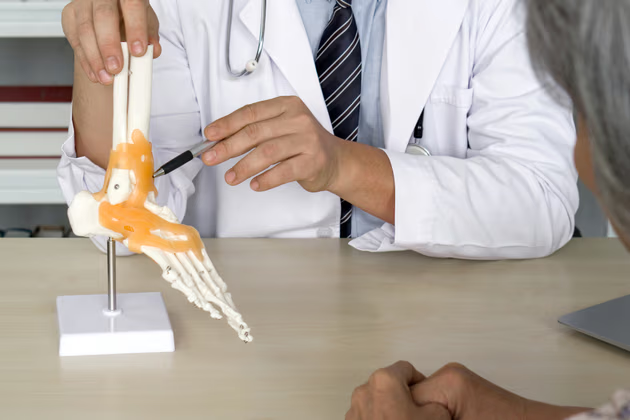

Most everyday foot pain isn’t serious — but “not serious” is not the same as “put up with it.” The point of the consultation is the diagnosis.

Professor Heidari

What patients describe

  • Experiencing pain when running or walking, particularly on the inner ankle and foot
  • Ankle swelling
  • Damage to the nerves in the foot on the inside of the ankle, causing numbness or a tingling sensation
  • Without treatment, the foot can lose flexibility and the problem can become harder to put right and cause arthritis, so getting an early diagnosis is key

Clinical approach

How Professor Heidari typically approaches it

Differentiate the diagnosis

“Pain in the foot” is a description, not a diagnosis. The first job of the consultation is to separate metatarsalgia from neuroma from stress reaction from fasciitis — they look similar, and they need different things.

Treat conservatively first

Footwear advice, custom or off-the-shelf orthotics, targeted physiotherapy, an injection where indicated. Most everyday foot pain settles with this combination.

Escalate only when it earns it

Surgery is rarely the right answer for everyday foot pain. When it is, the indication is specific and the operation is proportionate.

Treatments considered

The options

Flat feet (pes planus)

If your foot retains enough flexibility and the problem is caught early, flat feet can normally be treated with a course of physiotherapy, together with supporting your foot correctly by wearing insoles. Maintaining a healthy body weight and taking anti-inflammatory painkillers, as advised by your doctor, are other measures that will help keep the problem in check.

Ganglions

It may be possible, depending on the ganglion’s position, to treat the condition non-surgically through taking painkillers and wearing comfortable footwear. Alternatively, it may be best to have the fluid drained or aspirated, but in about 50% of cases, the ganglion can grow back.

Ingrown toenail

Ensuring your footwear is comfortable and fits properly is key. Cleanliness and changing socks or tights regularly are essential to avoid infection.

Common questions

What patients ask first

Do I need custom orthotics or will off-the-shelf do?
Off-the-shelf inserts work for many straightforward problems and are far cheaper. Custom orthotics earn their cost when there is a specific structural reason for them — not as a default.
Why does my foot only hurt in the morning?
Classic for plantar fasciitis — the fascia tightens overnight and the first steps stretch it sharply. A simple stretching routine and a gel heel cup help most patients.
Should I have an MRI?
Only if the result will change the plan. A clinical examination identifies most everyday foot complaints; MRI is used to confirm or to rule something specific in or out.
Can I keep running?
Usually yes, with adjustments. Most foot conditions tolerate a sensible reduction in volume better than a full stop — deconditioning has its own price.
Concerned about common foot conditions?

Talk it through with Professor Heidari

A consultation is a structured conversation, not a sales pitch. The diary holds while you decide.

Book a Consultation →

Signed off on 30 July 2026