



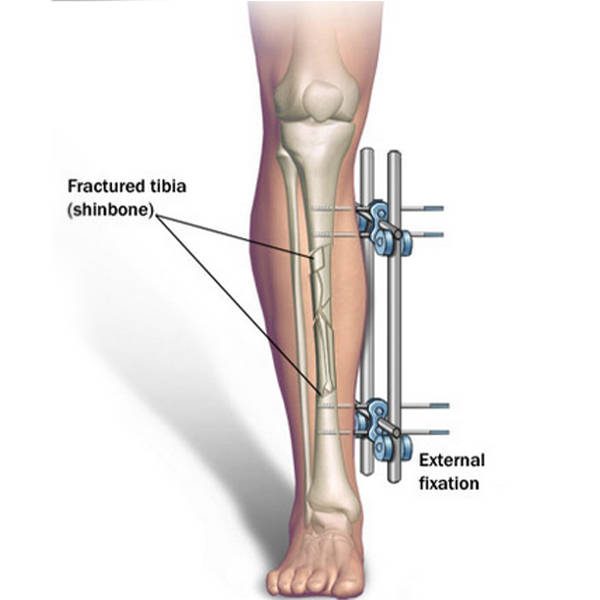
Bone transport is one of the most extraordinary techniques in modern orthopaedics. After a section of bone is lost — usually because of severe injury or because we’ve had to remove infected bone — we can grow new bone across the gap using nothing more than carefully controlled distraction. The body responds to the slow pull by laying down new bone in the gap. It is biology working at our pace.
The historical price
Until recently, bone transport almost always meant an external frame — an Ilizarov-style scaffold around the leg, held to the bone by wires that pass through the skin, adjusted by the patient at home several times a day. The biology works beautifully. The patient experience is, frankly, hard. Many months in a frame, daily pin-site care, sleep disrupted, clothes don’t fit. Patients put up with it because it works, but it is an enormous personal cost.
What we did
This 2019 paper, on which I was a co-author, describes a different approach for selected cases of massive femoral bone loss. We use a magnetic intramedullary nail — which lengthens by remote control held against the skin — combined with two locking plates. The whole reconstruction sits inside the leg. Nothing protrudes through the skin.
The patient experience
Bone transport still happens at the same biological pace as with a frame. But the daily reality is transformed. There are no pin sites to dress, no external scaffold to live with, no infection-prone wire tracks. Patients walk earlier, sleep better, and re-enter daily life much sooner.
The honest caveats
This isn’t a technique for every case. The right candidate has reasonable soft tissue cover at the gap, acceptable bone stock at each end of the defect, and a defect within a workable size range. Where infection is the underlying cause, source control comes first — the all-internal approach is not the right call until the field is clean. But for the right patient, it is a meaningful improvement on what we offered before.
Source: Wright J, Bates P, Heidari N, Vris A. All Internal Bone Transport: Use of a Lengthening Nail and Double Plating for Management of Femoral Bone Loss Strategies in Trauma and Limb Reconstruction 2019. PMID: 32742421. Read the full paper on PubMed →