




Most thigh-bone fractures heal, given the right operation. But a small minority don’t. The bone ends thin out, the fracture line refuses to bridge, and what should have been a 4–6 month process drags into a year, then two. Once a fracture has failed to heal it earns a clinical name: a non-union. Atrophic non-unions, where the bone ends look starved on the X-ray, are the toughest of the lot.
The trade-off between frames and nails
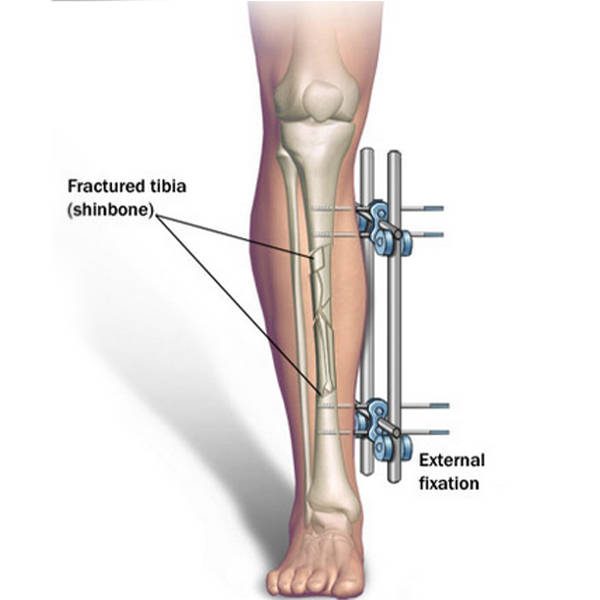
A surgeon facing an atrophic femoral non-union has historically had to choose between two main approaches. A frame — an external scaffold — gives precise control over alignment and compression at the fracture site, but it stays on for months and the patient has to live around it. A nail — an internal rod down the marrow cavity — gives long-term stable fixation, but is harder to use to drive controlled compression at the difficult fracture itself.
What we did
This 2018 paper, on which I was second author, describes using both at once: rail-and-nail. We start with the frame doing the active work — compressing the non-union, correcting any deformity, and providing the precise control these difficult fractures need. The nail sits inside the bone alongside the frame, ready to take over.
The transition
Once the frame has done its job — usually after a few months of compression and alignment — we remove the frame and proximally lock the nail. The bone now sits within the maximum working length of an internal rod, stable, with no external structure to manage. Pin-site infections and the patient’s daily frame-care burden end at that point.
What this means for patients
If you are dealing with a thigh-bone fracture that has refused to heal despite previous surgery, this combined approach offers the best of both techniques. It is not for every case, but for the right patient it shortens the time spent in a frame considerably.
Source: Davda K, Heidari N, Calder P, Goodier D. ‘Rail and Nail’ bifocal management of atrophic femoral nonunion Bone & Joint Journal 2018. PMID: 29701097. Read the full paper on PubMed →