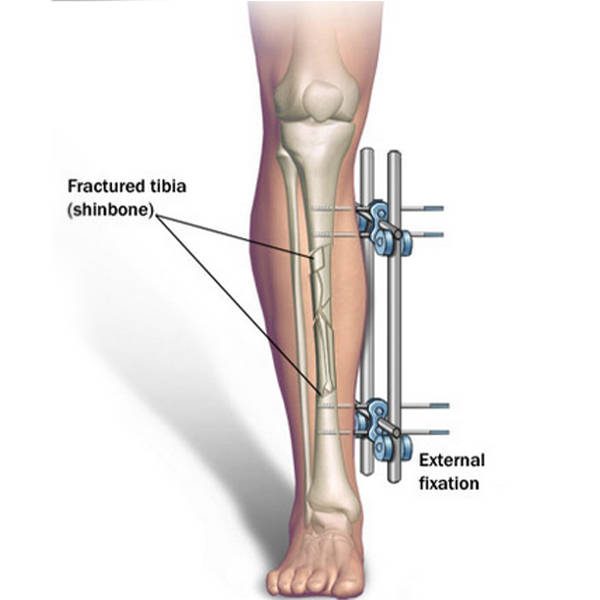





Having shown that computer-assisted hexapod surgery works well for the thigh, the natural next question was whether the same approach extends to the shin. The tibia is a more demanding territory: less soft-tissue cover, the peroneal nerve close to one side, the tibial artery close to the other, and a higher chance of compartment-pressure problems if anything goes wrong intra-operatively.
What we did
This 2016 paper, on which I was third author, reports our consecutive series of 13 procedures in 12 patients undergoing CHAOS for tibial deformity correction. The technique is the same as for the thigh: deformity mapped, correction calculated, hexapod adjusts the fragments intra-operatively, internal fixation holds the corrected position, hexapod comes off before the patient wakes up.
What we found
Complete correction of the deformity and full restoration of the mechanical axis was achieved in every patient. No non-unions. The complications were instructive: one superficial wound infection that needed implant removal after union, two cases of peroneal nerve palsy (one fully recovered, one partial), and a tibial-artery pseudoaneurysm that was successfully managed with a percutaneous stent.
What this means for patients
The complication profile is real and you should be told about it during consent — particularly the nerve risk. But against the alternative of months in an external frame, the in-theatre hexapod offers a substantial change in the patient experience. For complex multi-planar tibial deformity, it is now a strong option.
Source: Hughes A, Parry M, Heidari N, Jackson M, Atkins R, Monsell F. Computer Hexapod-Assisted Orthopaedic Surgery for the Correction of Tibial Deformities Journal of Orthopaedic Trauma 2016;30(7):e256–61. PMID: 27206256. Read the full paper on PubMed →