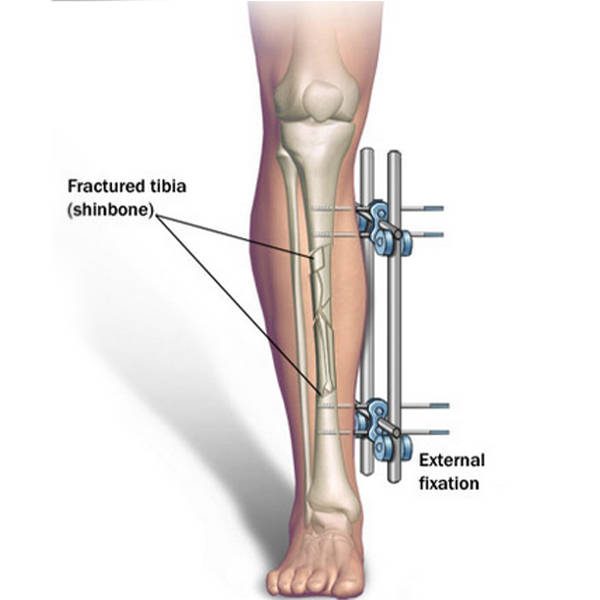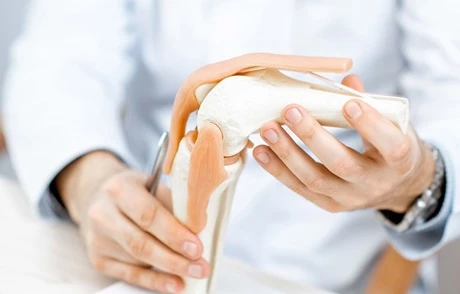




For most of orthopaedic history, correcting a deformity of the thigh bone meant living in an external frame for many months. The hexapod — a six-strut frame whose individual struts can be adjusted independently — gave us a precision tool, but the patient still lived around it. Modern computer-assisted techniques have changed that.
The CHAOS approach
CHAOS — Computer Hexapod-Assisted Orthopaedic Surgery — uses the hexapod intra-operatively. The deformity is mapped, the correction is calculated, and the hexapod adjusts the bone fragments into the corrected position while the patient is on the table. We then place internal fixation (a plate or nail) to hold the corrected position and remove the hexapod before the patient leaves theatre.
What we did
This 2017 paper, on which I was second author, describes our experience across 55 consecutive procedures in 49 patients. The cases included a wide range of indications — vitamin D resistant rickets, growth-plate arrest from childhood injuries, and post-traumatic deformities. Most needed correction in more than one plane simultaneously.
What we found
Multi-planar correction was achieved in 33 of 55 cases. The complication rate was low: two non-unions, one deep infection, one revision procedure, and no neurovascular injuries or compartment syndromes — the kind of catastrophic complications that older techniques sometimes carried.
What this means for patients
If you have a deformity of the thigh bone that needs correcting, ask whether CHAOS or a similar in-theatre hexapod technique is suitable for your case. For the right patient, it offers the precision of a frame technique without the months of living around one.
Source: Hughes A, Heidari N, Mitchell S, Livingstone J, Jackson M, Atkins R, Monsell F. Computer hexapod-assisted orthopaedic surgery provides a predictable and safe method of femoral deformity correction Bone & Joint Journal 2017;99-B(2):283–288. PMID: 28148674. Read the full paper on PubMed →